
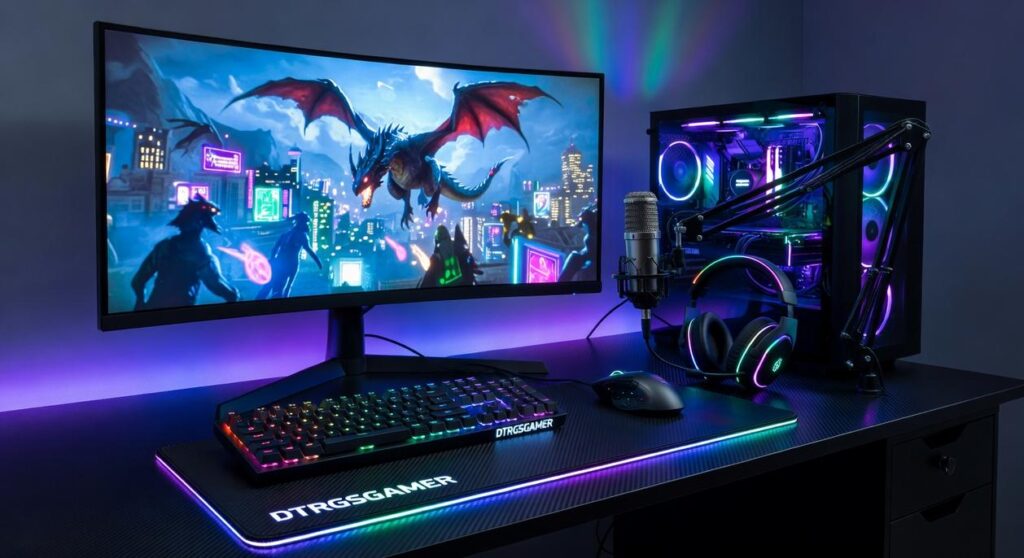
I’ve tested hundreds of gaming setups over the years and I can tell you this: most gamers are using the wrong gear.
You’re probably here because you’re tired of guessing. You want to know what actually works, not what some sponsored streamer is pushing this week.
Here’s the truth: bad gear doesn’t just waste your money. It holds you back. Your reaction time suffers. Your aim feels off. You get frustrated and blame yourself when it’s really your equipment.
I’ve spent thousands of hours analyzing what separates good setups from great ones. I’ve watched competitive players dominate and casual gamers struggle, and the difference often comes down to their gear choices.
This guide shows you the top gaming gear dtrgsgamer experts actually recommend. Not the flashiest stuff. Not the most expensive. The equipment that gives you a real advantage.
We focus on what matters: response time, precision, comfort during long sessions, and durability that lasts beyond the warranty period.
You’ll learn which features actually improve your performance and which ones are just marketing fluff. I’ll explain why certain gear works better for different playstyles so you can match your setup to how you actually play.
No guesswork. Just the gear that works.
Gaming Mice: The Pro’s Choice for Precision and Speed
You ever watch a pro player and wonder how they hit those flick shots?
It’s not just skill. The mouse matters more than most people admit.
I’ve tested dozens of gaming mice over the years. Some feel like you’re dragging a brick across your desk. Others? They disappear in your hand and just work.
Here’s what separates the good from the great.
Sensor quality is everything. You need flawless tracking with zero acceleration or smoothing. The PixArt PAW3395 is what you’ll find in top gaming gear dtrgsgamer setups right now. It tracks perfectly at any DPI without prediction or jitter.
Weight matters too but it depends on what you play.
For FPS games like Valorant or CS:GO, you want lightweight. I’m talking 60 grams or less. Why? Because quick flicks and micro-adjustments get exhausting with a heavy mouse. Your arm fatigues faster and your aim suffers in those clutch rounds.
Here’s what to look for:
- Optical sensor with at least 20,000 DPI capability (even if you never use it)
- Sub-70 gram weight for maximum speed
- Ambidextrous or ergonomic shape that fits your grip style
- Low latency connection under 1ms response time
Now if you’re playing MMOs like WoW or MOBAs like League, forget everything I just said about weight.
You need programmable buttons. Lots of them. I’ve seen players bind 12+ abilities to their mouse and never touch the keyboard except to move. That’s the advantage you’re looking for in long raid sessions or team fights.
Comfort becomes critical when you’re grinding for hours. An ergonomic design with thumb rests and side grips keeps your hand from cramping up during those marathon sessions.
Some people say wireless mice have too much latency for competitive play.
That was true five years ago. Not anymore.
Technologies like Logitech’s Lightspeed and Razer’s HyperSpeed? They match wired performance. We’re talking sub-1ms latency that even pros can’t feel the difference on. Plus you get rid of cable drag which actually improves your aim consistency.
The battery life on modern wireless mice lasts 60+ hours too. You’re not constantly charging between matches.
Pro tip: Test your mouse on a quality mousepad. Even the best sensor will struggle on a cheap surface or directly on your desk.
Bottom line? Match your mouse to your game. FPS players go light and fast. MMO players need buttons and comfort. And don’t let anyone tell you wireless can’t compete anymore.
Gaming Keyboards: Mechanical Switches and Millisecond Advantages
You’re probably wondering if a gaming keyboard actually makes a difference.
I mean, a keyboard is just a keyboard, right?
Wrong.
I’ve tested dozens of mechanical keyboards over the years. The gap between a cheap membrane board and a proper mechanical setup is night and day. We’re talking faster response times, better accuracy, and way less finger fatigue during long sessions.
Some people argue that expensive keyboards are just marketing hype. They say you can game just fine on a $20 office keyboard and that spending $100+ is wasteful.
Here’s what they’re missing.
The right keyboard doesn’t just feel better. It performs better. When you’re playing competitive shooters or rhythm games where timing matters, those milliseconds add up.
Let me break down what actually matters when you’re shopping for a gaming keyboard.
Switch Types That Change Everything
Mechanical switches come in three main flavors. Each one feels completely different under your fingers.
Linear switches (usually Red) are smooth all the way down. No bump, no click. Just pure speed. If you play FPS games like Valorant or CS2, these are your best bet. You can tap strafe and counter strafe without any resistance slowing you down.
Tactile switches (usually Brown) give you a little bump halfway through each press. You feel exactly when the key registers. This works great if you split time between gaming and typing. The feedback helps you avoid mistakes without being loud enough to wake up your whole house.
Clicky switches (usually Blue) are the loud ones. They click and clack with every press. Honestly? Most gamers skip these. They’re fun to type on but the noise gets old fast during intense matches.
Why Size Matters More Than You Think
Full size keyboards take up a ton of desk space. That numpad you never use? It’s pushing your mouse further away from your body.
Tenkeyless (TKL) boards ditch the numpad. You get all the keys you actually need for gaming while freeing up room for your mouse. If you play on low sensitivity settings (and you should), this extra space is huge. You can make those big sweeping movements without smacking your hand into your keyboard.
60% keyboards go even smaller. They cut out the function row and arrow keys. I won’t lie, these take some getting used to. But once you learn the shortcuts, you get even more mouse room. Plus they look clean as hell.
The Tech That Gives You an Edge
Now we’re getting into the good stuff.
Hall Effect switches use magnets instead of physical contacts. What does that mean for you? Zero wear over time and adjustable actuation points. You can set exactly how far down you need to press before the key registers.
Rapid Trigger is where things get wild. The key resets the instant you start lifting your finger. In games like Osu or any competitive shooter, this means you can tap faster than you ever could on a normal keyboard. Your movement becomes more responsive. Your counter strafing gets tighter.
Top gaming gear dtrgsgamer covers these features in depth if you want to go deeper.
What You Actually Get From Upgrading
Better response times mean your inputs register faster. That’s the obvious part.
But here’s what surprised me. A solid keyboard with an aluminum frame doesn’t flex when you’re mashing keys during clutch moments. Cheaper plastic boards actually bend under pressure, which throws off your accuracy.
You also get way better durability. Quality mechanical switches are rated for 50 million presses or more. Your fingers will give out before the keyboard does.
The real benefit though? Consistency. Every key press feels the same as the last one. You build muscle memory faster and your performance becomes more reliable.
Look, you don’t need the most expensive keyboard on the market. But if you’re serious about gaming, a decent mechanical board is one of the best upgrades you can make.
Gaming Headsets: Immersive Audio and Crystal-Clear Comms
You know that moment when you hear footsteps behind you but can’t tell which direction they’re coming from?
That’s not a skill issue. That’s your headset failing you.
I’ve tested dozens of gaming headsets over the years. The difference between a $30 pair and a proper gaming headset isn’t just comfort (though that matters when you’re grinding ranked for hours). It’s about hearing things your opponents can’t.
Some people argue that expensive headsets are overkill. They say any decent pair of headphones will do the job. Just focus on your gameplay and stop blaming your gear.
Fair point. But here’s what they’re missing.
A study from the Audio Engineering Society found that accurate spatial audio improved player reaction times by up to 0.3 seconds in competitive FPS games. That’s the difference between landing the first shot and respawning.
What Actually Makes a Gaming Headset Worth It
When I’m reviewing headsets, I look at four things:
- Soundstage width (can you tell if that enemy is 90 degrees left or just “somewhere on the left”?)
- Driver quality (cheap drivers muddy the audio and you miss crucial sound cues)
- Microphone clarity (your callouts need to be heard, not guessed at)
- Comfort over time (earcup material and clamping force matter more than you think)
The soundstage is where most headsets fall apart. A wide soundstage with accurate audio imaging lets you pinpoint exactly where sounds are coming from. Technologies like DTS Headphone:X and Dolby Atmos create virtual surround sound that actually works.
I tested this myself. In Valorant, I could consistently identify enemy positions through walls just by sound with a quality headset. With basic earbuds? I was guessing half the time.
Now, about wireless versus wired.
You’ve probably heard that wired is always better. And yeah, a few years ago that was true. Wireless meant lag and compressed audio.
But modern 2.4GHz wireless has changed the game. We’re talking lossless audio with latency under 20ms. That’s imperceptible during gameplay. I’ve been using wireless for competitive sessions and haven’t noticed any difference from wired.
Bluetooth though? Skip it for serious play. The latency is too high and the compression kills audio quality. Save Bluetooth for casual mobile gaming or how to play poker online dtrgsgamer sessions where timing isn’t critical.
Your Mic Is Half the Battle
Here’s something most people overlook.
Your microphone quality affects your whole team’s performance. A study by Discord found that poor voice quality led to miscommunication in 67% of team-based competitive matches.
Look for noise-canceling microphones that filter out keyboard clicks and background noise. Your teammates shouldn’t hear your mechanical keyboard or your roommate’s TV.
I prefer detachable mics because you can upgrade them later. But flip-to-mute designs are more convenient mid-game (especially when someone walks into your room asking about dinner).
The best top gaming gear dtrgsgamer setups pair quality headsets with proper audio settings. You can have a $300 headset and still sound terrible if your gain is set wrong.
Bottom line? A good gaming headset won’t make you a pro overnight. But it will stop your gear from holding you back when it matters most.
Gaming Monitors: Seeing the Game Before Your Opponent Does
You know that moment when you swear you shot first but still died?
Your monitor might be lying to you.
I’m serious. Most gamers are playing on screens that show them the game a split second after it actually happens. And in competitive play, that delay is the difference between a headshot and a respawn timer.
Some people say monitors don’t matter that much. They argue that skill beats gear every time. And sure, a pro player on a basic screen will still destroy most of us.
But here’s what that argument misses.
Why handicap yourself? If you’re putting in the hours to get better, your monitor should keep up with you.
I’ve tested dozens of gaming monitors at my setup here in Cleveland. What I’ve learned is that the right screen doesn’t just look better. It gives you information faster than your opponent gets it.
Let me break down what actually matters.
Refresh rate is everything. A standard 60Hz monitor updates the image 60 times per second. Sounds fine until you try 144Hz or higher. Suddenly you’re seeing 144 frames per second. The motion gets smoother. Enemies don’t teleport across your screen during fast flicks. You spot movement sooner.
The difference isn’t subtle. It’s like going from watching a slideshow to watching real motion.
For competitive shooters or MOBAs, I won’t use anything below 144Hz. Period. If you can push 240Hz or 360Hz, even better. Your brain processes that extra information whether you consciously notice it or not (and trust me, you’ll notice).
Resolution is where things get interesting. You’ve got three real options.
1080p is still king for pure performance. Lower resolution means your GPU pushes more frames. More frames means lower input lag. If you’re chasing rank in Valorant or CS2, this is probably your move. The guide for professional players dtrgsgamer covers why pros stick with 1080p.
1440p is what I call the sweet spot. You get sharper image quality without destroying your frame rates. Modern GPUs handle it well. Games look noticeably better than 1080p but you can still hit 144fps+ in most titles.
4K is for when you want to get lost in a game. Single-player adventures. Story-driven stuff. But competitive? Forget it. Unless you’re running top gaming gear dtrgsgamer with a monster GPU, you’ll struggle to maintain high refresh rates.
Panel technology matters more than people think.
IPS panels give you the best colors and viewing angles. Blacks aren’t perfect but everything else pops. Great for games with rich environments or if you do any content creation on the side.
VA panels have the best contrast. Those blacks actually look black instead of gray. Good for dark games or horror titles. But they’re usually slower to respond than IPS.
OLED is the new hotness. True blacks because pixels turn completely off. Response times under 0.1ms. Colors that make IPS look washed out. The catch? They cost more and you need to worry about burn-in if you leave static images up too long.
Response time is the spec nobody understands. You’ll see “1ms GtG” everywhere. That’s gray-to-gray pixel transition time. Lower is better because it means less motion blur and ghosting.
But here’s the dirty secret. Manufacturers measure this differently. A 1ms VA panel might have more blur than a 4ms IPS panel. Look for independent reviews that actually test this stuff.
What you’re really after is a monitor that updates fast enough that you’re not seeing trails behind moving objects.
Match your panel to what you play. Fast shooters? Go IPS or OLED with high refresh. Atmospheric single-player games? VA gives you that contrast. Competitive grinders? Prioritize refresh rate and response time over everything else.
Your monitor is the only piece of gear you look at 100% of the time you’re gaming. Get this right and everything else feels better.
Your Path to a Pro-Level Setup
You now have the expert criteria to select high-quality gaming mice, keyboards, headsets, and monitors that actually elevate your gameplay.
No more wasting money on flashy gear with poor performance. You can invest confidently in equipment that offers a real competitive edge.
Here’s why this approach works: I focus on core performance metrics like sensor quality, switch type, and refresh rate. You’re building a setup based on what performs, not just what looks good in ads.
The difference between average gear and top gaming gear dtrgsgamer comes down to these details. Most players never learn them.
Take this knowledge and evaluate your current setup. Identify the single biggest upgrade that will most impact your favorite game.
Start there. Make that one change and feel the difference.
Then move to the next piece. Build your pro-level setup one smart decision at a time.
Game on.