
I’ve sat at thousands of online poker tables and I can tell you this: most beginners lose money in their first few sessions because they skip the basics.
You’re probably here because you want to start playing online poker but you’re not sure where to begin. Maybe you’ve watched it on TV or played casual games with friends. But online poker feels different. Faster. More serious.
How to play poker online dtrgsgamer breaks down everything you need to know before you risk a single dollar.
Here’s the thing: online poker has its own rhythm and language. The action moves quick and if you don’t understand the fundamentals, you’ll burn through your bankroll before you figure out what went wrong.
I’ve spent years playing online and I’ve seen the same mistakes over and over. New players jump in without knowing position strategy. They chase bad hands. They misread the table dynamics.
This guide cuts through all that.
You’ll learn the essential rules that matter at a virtual table. I’ll show you the core strategies that keep you competitive from day one. And I’ll point out the critical mistakes that cost beginners the most money.
No complex theory. No advanced tactics you won’t use yet.
Just the foundation you need to sit down at your first online table and play with confidence.
The Absolute Essentials: Understanding the Game Before You Play
You can’t win at poker if you don’t know what beats what.
Sounds obvious, right? But I’ve seen people sit down at tables (even online) without knowing if a flush beats a straight. That’s like trying to play basketball without knowing how many points a three-pointer is worth.
Let me walk you through what you actually need to know before you play your first hand.
Poker Hand Rankings (The Unskippable Part)
Memorize these. I mean it. You need to know these backwards and forwards.
From weakest to strongest:
High Card is when you’ve got nothing. Your highest card is all you have.
One Pair means two cards of the same rank. Two kings, two fives, whatever.
Two Pair is exactly what it sounds like. Kings and fives together.
Three of a Kind gives you three cards of the same rank.
Straight means five cards in sequence. Like 5-6-7-8-9.
Flush is five cards of the same suit. All hearts or all spades.
Full House combines three of a kind with a pair.
Four of a Kind is four cards of the same rank.
Straight Flush gives you five sequential cards of the same suit.
Royal Flush is the big one. 10-J-Q-K-A all in the same suit.
Write these down. Quiz yourself. You need to know them instantly when you learn how to play poker online dtrgsgamer.
The Flow of a Hand (Texas Hold’em)
Every hand follows the same pattern.
Pre-Flop starts when everyone gets two cards face down (your hole cards). The two players left of the dealer post blinds. Then betting begins.
The Flop comes next. Three community cards hit the table face up. Another betting round starts.
The Turn adds one more community card. You’ve got four cards on the table now. More betting happens.
The River is the final community card. Last betting round before showdown.
Key Terminology
Blinds are forced bets that two players make before cards are dealt. Small blind and big blind keep the action moving.
Button is the dealer position. It rotates clockwise after each hand.
Pot is all the money in the middle that you’re fighting for.
Check means you pass without betting (only if no one has bet yet).
Bet is when you put money in the pot.
Call means you match the current bet.
Raise is when you increase the current bet.
Fold means you’re out for this hand.
That’s it. Those are your essentials.
Your First and Most Important Decision: Pre-Flop Strategy
Most beginners lose money before they even see the flop.
I’m serious. You’re bleeding chips in the first 30 seconds of every hand because you’re playing too many cards from the wrong spots.
When I started learning how to play poker online dtrgsgamer, I made the same mistakes. I thought any two face cards were worth playing. I’d limp in with suited connectors from early position and wonder why I kept losing.
Here’s what changed everything for me.
Position is everything.
When you act last, you get to see what everyone else does before you make your move. That’s huge. You have more information than anyone else at the table.
Let me break this down. Early position means you’re one of the first to act (right after the blinds). Middle position is the seats after that. Late position is the button and the seat right before it.
In early position? Play tight. You’re at a disadvantage because you act first on every street after the flop.
In late position? You can open up a bit. You’ll see what everyone does before it’s your turn.
Start with strong hands only.
I know it’s tempting to play more hands. Sitting there folding gets boring fast.
But here’s my recommendation. Stick to premium hands when you’re learning:
- Big pairs: AA, KK, QQ, JJ
- Strong Broadway cards: AK, AQ
- Maybe TT and AJ from late position
That’s it. Fold everything else until you get comfortable.
If it’s worth playing, it’s worth raising.
This is the golden rule I wish someone had drilled into my head earlier.
Limping (just calling the big blind) is weak. You’re not taking control of the hand. You’re inviting everyone to see a cheap flop and potentially outdraw you.
When you raise, you’re putting pressure on your opponents. You’re building the pot with your strong hands. You’re making it expensive for weaker hands to stick around.
Keep your bet sizing simple.
Raise to 3x the big blind from any position. If someone’s already raised, make it 3x their raise.
Don’t overthink it. Consistent sizing keeps you from giving away information about your hand strength.
Some players will tell you to vary your bet sizes to be unpredictable. And sure, at higher levels that matters.
But right now? Just use 3x and focus on everything else.
Navigating Post-Flop: What to Do After the First Cards Are Dealt
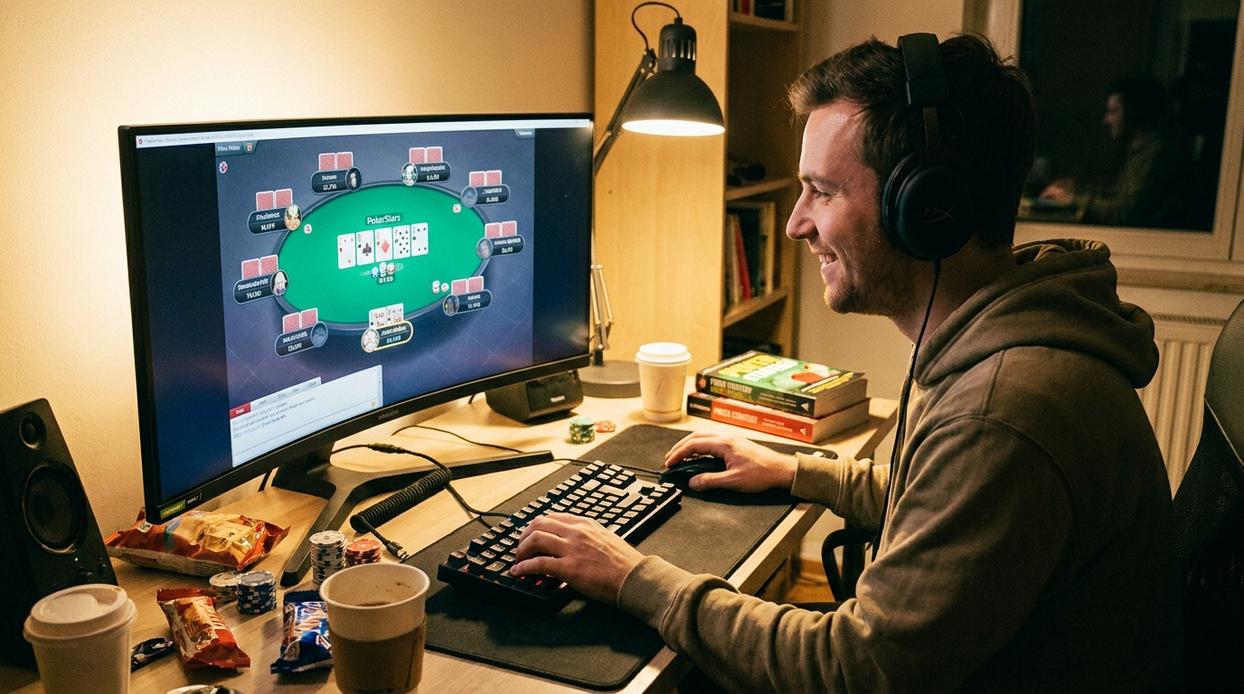
The flop just hit the table.
Three cards staring back at you. And now you’ve got a decision to make.
Did you connect with those cards? That’s the first question I ask myself every single time.
Maybe you flopped a pair. Maybe you’ve got four cards to a flush (that’s called a draw). Or maybe you completely whiffed and those three cards did absolutely nothing for your hand.
Here’s where most players mess up. They fall in love with their starting hand and forget that poker is about what you have right now, not what you started with.
Let me walk you through what actually matters after the flop.
Understanding the Continuation Bet
If you raised before the flop, you were showing strength. The continuation bet (or C-Bet) is when you keep that story going by betting again on the flop.
Think of it this way. You told everyone you had a good hand. Now you’re backing up that claim whether you hit the flop or not.
The C-Bet works because your opponents often missed too. When you bet, they fold. Simple as that.
But don’t go crazy with it. If you C-Bet every single flop, smart players will catch on fast.
Pot Odds Made Simple
You’ve probably heard people talk about pot odds like it’s some complex math problem.
It’s not.
Here’s all you need to know. Is the money you could win worth the money you have to risk?
Say there’s $100 in the pot and someone bets $20. Now there’s $120 total and it costs you $20 to call. You’re getting 6 to 1 on your money.
If you’ve got a flush draw (you need one more card of your suit), you’ll hit it about 1 in 4 times by the river. Those odds? They’re worth the call.
That’s pot odds. Nothing fancy about it.
Knowing When to Walk Away
This is the hard part.
You raised with pocket jacks before the flop. The flop comes down with three low cards and your opponent fires a big bet at you.
Some players think, “I started with a good hand so I should keep playing.”
Wrong move.
Your opponent is telling you they’ve got something. Maybe they flopped two pair. Maybe a set. Either way, your jacks aren’t looking so hot anymore.
The dtrgsgamer gaming guide by digitalrgs covers this concept in detail, but the basic idea is straightforward. Don’t marry your starting hand.
If you missed the flop and someone’s betting into you, folding isn’t weak. It’s smart.
Save your chips for spots where you actually connect. That’s how to play poker online dtrgsgamer style and keep your stack healthy for the long run.
The flop is just the beginning. But if you can nail these basics, you’re already ahead of half the players at your table.
The Mental Game: Bankroll Management and Avoiding Tilting
You can have the best poker strategy in the world and still go broke.
I’ve seen it happen more times than I can count. Players who know the odds, understand position, and read hands well. But they can’t manage their money or their emotions.
That’s where most people lose.
What is Bankroll Management?
Here’s the rule I follow. Never play with money you can’t afford to lose. Period.
If losing that cash means you can’t pay rent or buy groceries, you shouldn’t be at the table. This isn’t about being scared. It’s about staying in the game long enough to actually win.
Think of your bankroll as your poker business fund. You need enough cushion to handle the swings. Because trust me, the swings will come.
I recommend keeping at least 20 to 30 buy-ins for whatever stake you’re playing. Playing $1/$2? You should have $4,000 to $6,000 set aside. Sounds like a lot, right?
But here’s what you get from proper bankroll management. You can handle bad beats without panicking. You won’t feel desperate to win back losses in a single session. And you’ll make better decisions because you’re not playing scared money.
The Top 3 Beginner Mistakes
Most new players make the same errors. I made them too when I started with how to play poker online dtrgsgamer.
Playing too many hands. You get bored waiting for good cards, so you start playing junk. Then you’re stuck in a hand you should’ve folded, throwing good money after bad.
Getting too emotional. This is called tilting. You take a bad beat and suddenly you’re playing every hand trying to win it back. I’ve watched players lose their entire stack in 20 minutes because they couldn’t control themselves after one unlucky river card.
Not paying attention to opponents. You’re focused on your cards and missing everything else. That’s like playing chess with your eyes closed.
Playing the Player, Not Just the Cards
Some people think poker is just about the cards you hold.
They’re missing half the game.
Watch your opponents. Even online, you can pick up patterns. Does this player always bet big with strong hands? Do they fold too often to aggression? Are they playing every hand or waiting for premium cards?
These tells matter more than you think. Because once you know how someone plays, you can beat them even when they have better cards.
You’re Ready for the Virtual Felt
You came here wondering how to play poker online dtrgsgamer without losing your shirt.
Now you know the rules. You understand the core strategy. You’ve got a money management plan that protects your bankroll.
The fear and confusion you felt before? That’s normal. Every successful online poker player started exactly where you are right now.
Here’s why this approach works: You’re playing tight and staying patient. You’re being aggressive when you have strong hands. You’re not risking money you can’t afford to lose.
Those three things keep you out of the biggest beginner traps.
It’s time to stop reading and start playing.
Find the lowest stakes tables you can (we’re talking pennies here). Pick one concept from this guide and focus on it during your session. Maybe it’s folding weak hands or betting your strong pairs.
Don’t try to master everything at once.
And remember why you wanted to learn this in the first place. Online poker should be fun. The strategy makes it more fun because you’re not just gambling blindly.
You’ve got what you need. Now go play some cards.