
You’ve mastered the mechanics. You climb the ranks. But you’ve hit a ceiling.
I know that feeling. You’re in the top 10% but the top 1% feels impossible to reach.
Here’s the truth: the skills that got you this far won’t get you to pro level. What worked when you were grinding through the ranks doesn’t work anymore.
The gap between great and pro isn’t about playing more hours. It’s about playing differently.
Most guides tell you to practice harder or watch more replays. That’s not what separates talented players from professionals. The real difference is moving from intuitive play to deliberate strategy.
This guide for professional players dtrgsgamer skips the generic advice. I’m giving you the structured framework that pros actually use to perform at an elite level consistently.
You’ll get a concrete roadmap. We’re covering the mental game, the strategic thinking, and the physical disciplines you need to make the jump from talented competitor to professional.
No fluff about grinding harder. Just the specific changes that turn good players into pros.
The Professional Mindset: Rewiring Your Brain for Victory
You know that feeling when you’re in a match and everything just clicks?
Your reactions are sharp. You’re reading plays before they happen. You’re not tilting after a bad fight.
That’s not luck. That’s what separates casual players from pros.
Most players think they just need better mechanics. They spend hours grinding games and wonder why they’re stuck at the same rank. (I see this all the time at dtrgsgamer.)
Here’s what they miss. Your brain is the most important muscle you have.
From Reactive to Proactive Play
Stop playing defense in your own head.
Reactive players respond to what’s already happening on screen. They see an enemy and fight. They watch objectives get taken and scramble.
Proactive players think three steps ahead.
When I coach players, I ask them one question: Where will the enemy be in 30 seconds?
Most can’t answer. But that’s the whole game right there.
Start tracking cooldowns. Not just ultimates but key abilities. If their jungler just used flash top lane, you know exactly where to apply pressure for the next five minutes.
Watch the map like it’s telling you a story. Enemy mid just backed with full HP? They’re probably roaming bot. Their support disappeared? Ward’s going down right now.
This is what the guide for professional players dtrgsgamer teaches. Prediction beats reaction every single time.
Mastering Mental Fortitude
Let me be real with you.
You’re going to have bad games. Your teammate will int. You’ll miss that crucial skillshot. It happens.
The difference between climbing and staying stuck? What you do in the next 10 seconds.
Here’s what works:
Tactical breathing. Breathe in for four counts. Hold for four. Out for four. Sounds simple but it stops the tilt spiral before it starts.
The 10-second reset. After a bad fight, give yourself exactly 10 seconds. Feel whatever you need to feel. Then it’s over. Next play.
Forward focus only. Your last mistake is already in the past. You can’t change it. But you can win the next fight.
I learned this the hard way. I used to rage at every death and wonder why I kept losing winnable games. Turns out carrying emotional baggage into the next teamfight is a great way to lose twice.
Embracing Deliberate Practice
Here’s the truth nobody wants to hear.
Playing 50 games this week won’t make you better. Not if you’re just autopiloting through them.
Grinding games means you’re repeating the same mistakes over and over. You’re building bad habits into muscle memory.
Deliberate practice means you pick one thing and focus on it completely.
Today? I’m tracking the enemy jungler’s pathing. That’s it. I don’t care if I miss CS. I don’t care if my KDA suffers. I’m learning jungle patterns.
Tomorrow? Maybe I’m working on wave management. Or I’m practicing my combos in one specific matchup.
One focus per session. That’s how pros actually improve.
Your brain can’t optimize everything at once. Give it a single target and watch how fast you level up.
Advanced Strategy: How to Deconstruct and Dominate the Meta
Most players watch their replays wrong.
They sit there for an hour, watch themselves die three times, and think “I need better mechanics.” Then they queue up again and make the same mistakes.
I’m going to show you a different way.
The Three-Tier VOD Review System
Tier 1: Your POV
Start here but don’t stay here. Watch for mechanical errors. Missed skillshots. Bad positioning. The obvious stuff.
Spend five minutes max. Write down two things you messed up and move on.
Tier 2: Enemy POV
This is where it gets interesting. Rewatch the same fights from their perspective (most games let you do this in replay mode).
What were they trying to do? When did they decide to engage on you? What information did they have that you didn’t?
You’ll notice something. They didn’t outplay you because they’re gods. They won because you gave them what they needed.
Tier 3: Map-Wide POV
Pull the camera way out. Watch the whole map at 2x speed.
Look at objective timers. Where was your team when dragon spawned? Who had priority? Did you rotate when you should have stayed?
This tier shows you the game behind the game.
Identifying and Forcing Win Conditions
Here’s what separates good players from great ones.
Great players know how to win in the first 60 seconds of the match. They look at both team compositions and immediately identify the win condition.
| Team Comp Type | Win Condition | Communication Priority |
|——————-|——————|—————————|
| Early Game Stomp | Secure first objectives, end by 25 min | “We need to fight for every early objective” |
| Late Game Scale | Stall, farm, avoid fights pre-20 | “Play safe, we outscale at 3 items” |
| Pick Comp | Catch isolated targets, control vision | “Ward deep, look for picks before objectives” |
You need to type this in chat. Not everyone will listen but the ones who do will follow your lead.
When I’m playing on guide for professional players dtrgsgamer, I make this call before minions spawn. It works.
Elite-Level Resource Management
Everyone knows about mana and health.
But what about the resources nobody talks about?
Cooldown Economy
Your ultimate has a three-minute cooldown. That means you get maybe four uses in a 15-minute window. Are you using it to secure kills that matter or wasting it on trades that go nowhere?
Information Trading
Every ward you place is information you’re giving up later. You only have two. If you drop both in river at minute three, you’re blind for the next 90 seconds.
Same with scans and reveals. Use them to confirm, not to search.
Positional Advantage
This one’s tricky. Your position on the map is a resource you can trade. Give up mid tower to take their jungle camps. Trade bot lane pressure for top lane control.
Most players think position is binary. You either have it or you don’t.
Wrong. Position is currency. Spend it where it counts.
The Performance Ecosystem: Optimizing Your Physical and Digital Setup
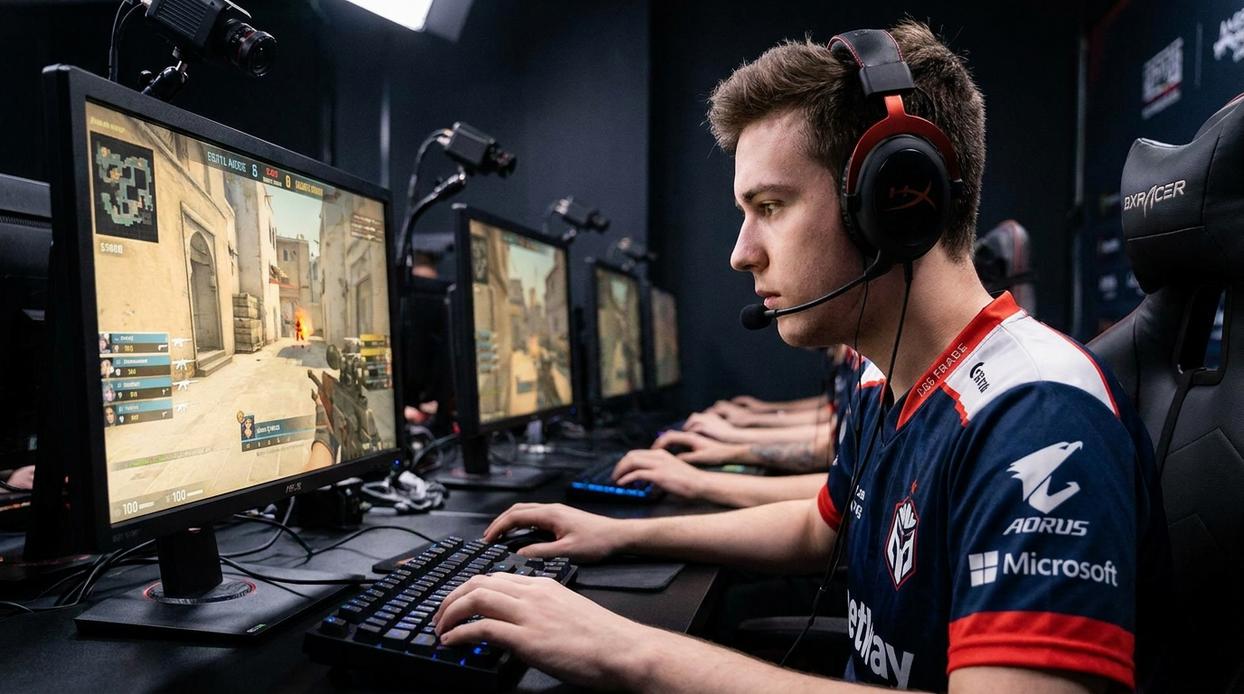
Your setup can make or break your game.
I’m not talking about RGB lights or fancy chairs that look cool on stream. I’m talking about the stuff that keeps you sharp when you’re six hours into a tournament and every millisecond counts.
Most players think comfort is the goal. Get a nice chair, position your monitor somewhere that feels good, and you’re set.
Wrong.
Comfort matters, sure. But what you really need is a setup that prevents fatigue and keeps your aim consistent when it matters most.
Ergonomics for Endurance and Precision
Here’s what people get backwards about ergonomics.
They optimize for how they feel in the first hour. But tournament days aren’t one hour. They’re marathons where your body position at hour six determines whether you clutch or choke.
Your monitor distance affects more than your neck. Too close and your eyes work overtime tracking movement across the screen. Too far and you miss details that could save your life in game.
I keep mine at arm’s length. When I extend my arm fully, my fingertips just touch the screen.
Mouse grip is where I see the biggest mistakes. Players copy what pros do without understanding why. Palm grip versus claw grip isn’t about preference. It’s about which one you can maintain without your hand cramping after 200 matches.
Test this yourself. Play three hours with your current grip and notice where tension builds. That’s your problem area.
Posture isn’t about sitting up straight like your mom told you. It’s about keeping your shoulders relaxed and your wrists neutral so you’re not fighting your own body while trying to aim.
Fine-Tuning Your Hardware
Everyone wants to know what DPI the pros use.
That’s the wrong question.
The right question is: what settings give you the most consistent aim across different scenarios?
High DPI with low in-game sensitivity versus low DPI with high sensitivity can feel identical. But one might work better with your mouse sensor. The only way to know is testing.
I run 800 DPI with moderate in-game sens. Not because some streamer does. Because after weeks of testing, that’s where my flicks and tracking both feel natural.
Monitor refresh rate gets overhyped. Yes, 240Hz is smoother than 144Hz. But the jump from 60Hz to 144Hz is massive while 144Hz to 240Hz is barely noticeable for most players.
If you’re choosing between better top gaming gear dtrgsgamer and a higher refresh rate, get the gear first. A 144Hz monitor with a good mouse beats a 240Hz monitor with a cheap mouse every time.
Here’s the comparison that matters:
Consistency versus peak performance. Some players chase the absolute lowest input lag and highest refresh rate. Others prioritize settings they can replicate anywhere. If you travel to tournaments, you need settings that work on different setups.
I’d rather have good aim on any system than perfect aim on only my home rig.
The Athlete’s Edge: Sleep, Nutrition, and Hydration
You can have perfect posture and ideal settings.
But if you’re running on four hours of sleep and energy drinks, you’re cooked.
Your reaction time drops about 10% when you’re sleep deprived (and that’s being generous). Decision making gets worse. Focus falls apart in clutch moments.
I learned this the hard way. Used to pull all nighters before tournaments thinking I needed the practice. Then I’d wonder why I couldn’t hit shots I made easily in scrims.
Now I treat sleep like part of my training. Seven to eight hours minimum before competition days.
Nutrition isn’t complicated. Eat real food. Protein keeps you full without the crash. Carbs give you energy but time them right or you’ll be sluggish mid match.
Hydration is simpler than people make it. Drink water throughout the day. Not just when you’re thirsty, because by then you’re already behind.
Skip the energy drinks during matches (I know, controversial). They spike you hard then drop you harder. Water and maybe coffee if you need it.
Your brain is part of your body. Treat it like the high performance tool it is and you’ll see the difference in your game.
Beyond Solo Queue: Integrating into a Team Environment
Communication That Wins Games
You know that moment in The Avengers where everyone’s talking over each other during the Battle of New York?
That’s what bad team comms sound like.
Clutter is when you’re narrating every single thing you see. “Enemy top, enemy mid, I’m low, I need help, wait never mind, okay I’m good, actually no I’m not.”
Clarity is different. It’s “Jungler top, no flash, 30 seconds.”
See the difference? One gives your team something they can act on. The other just fills the channel with noise.
Here’s what good callouts look like. “Roam mid” instead of “I think maybe someone should probably rotate to mid lane because I saw their support leave bot.” Or “Back, Baron bait” instead of a full explanation of why you think the enemy team is setting up an ambush.
If you’re serious about this (and wondering which headphones should i get dtrgsgamer for clearer comms), start by saying less. Your teammates don’t need a play-by-play. They need information they can use in the next five seconds.
The Purpose of Scrims
Most players treat scrims like ranked matches they need to win.
Wrong approach.
Scrimmages are your lab. They’re where you test that weird draft composition or practice a specific macro rotation. Winning is nice but it’s not the point.
Before each scrim, pick one thing to work on. Maybe it’s your team’s vision control around objectives. Maybe it’s executing a specific early game strategy. Write it down.
Then play the scrim with that goal in mind. Did you get the data you needed? Did the strategy work or fall apart? That’s what matters.
Think of it like a band rehearsal. You’re not trying to impress anyone. You’re trying to get tight as a unit. The guide for professional players dtrgsgamer is built around this exact principle.
Giving and Receiving Constructive Feedback
Post-game reviews go sideways fast if someone starts pointing fingers.
Here’s a better way. Focus on decisions, not players. Instead of “You threw the game,” try “What was the call on that Baron attempt?”
Ask questions first. “What were you seeing when you engaged there?” Sometimes your teammate had information you didn’t. Sometimes they just messed up. Either way, you learn something.
When you’re getting feedback, resist the urge to defend yourself immediately. Just listen. Even if you disagree, there’s usually something useful buried in there.
I like to end reviews with one thing each person will focus on next game. Not five things. One. Because trying to fix everything at once fixes nothing.
Your Path to Professional Begins Now
You came here stuck at a skill ceiling that felt impossible to break through.
Now you have the blueprint to move beyond that plateau.
The gap between experienced and pro isn’t closed by playing more. It’s closed by playing smarter.
I’ve seen too many talented players grind for thousands of hours without real progress. They’re missing the framework that separates good from great.
This guide for professional players dtrgsgamer works because it treats gaming as a professional discipline. It’s about mindset, strategy, and optimization.
Not just raw hours.
Here’s your challenge: Pick one specific strategy from this guide. I recommend starting with the Three-Tier VOD Review.
Apply it consistently for the next seven days.
Track your progress. You’ll see measurable improvement if you commit to the process.
The difference between where you are now and where you want to be comes down to deliberate practice. You have the tools now.
What you do with them in the next week will tell you everything you need to know about your potential.